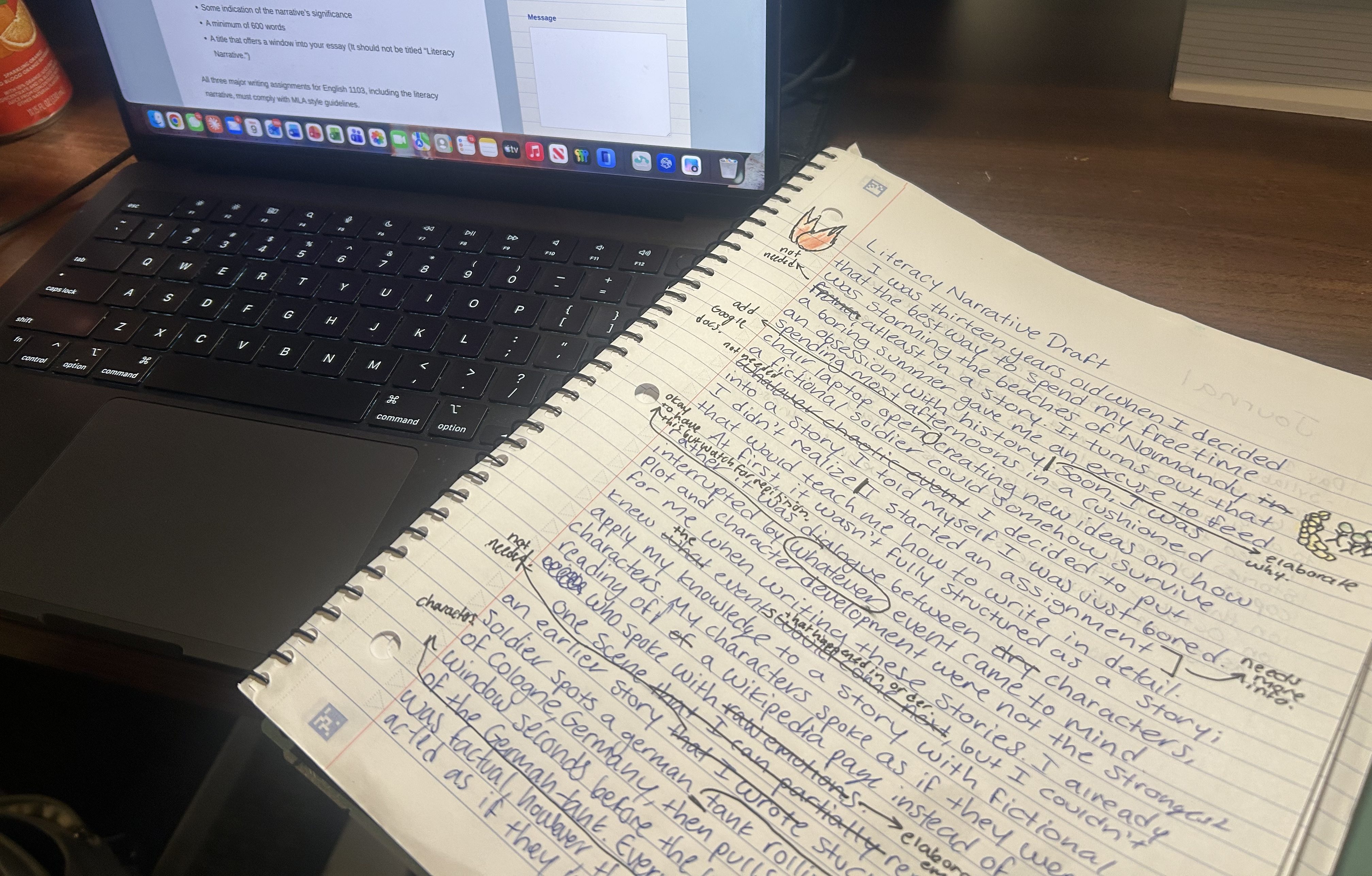
I was thirteen years old when I decided the best way to spend my free time was storming the beaches of Normandy, in a story at least. It turns out that a boring summer gave me an excuse to feed an obsession with history that my grandfather imprinted years ago. My grandfather would talk about World War II as if he experienced it firsthand, and between visits, everything he told me sat in my head until I started writing it into stories of my own. Soon, I was spending most afternoons in a cushioned chair, laptop open to Google Docs, creating new ideas on how a fictional soldier could somehow survive whatever I threw at him. Some days, I’d write for hours without noticing the time. I told myself I was just bored. I didn’t realize I’d already given myself the one assignment that would teach me to write in detail.
At first, it wasn’t fully structured as a story; rather it was dialogue between characters, interrupted by whatever sudden event came to mind. Plot and character development were not my expertise when writing these stories. I already knew every event that happened in order, but I couldn’t apply my knowledge to a story with fictional characters. My characters spoke as if they were reading off a Wikipedia page instead of characters who spoke in a scared, homesick, and exhausted manner.
One scene from an early story that I wrote stuck with me. A soldier spots a German Panther tank rolling down the street in Cologne, Germany, then pulls his friend from the window seconds before the wall crumbles to pieces. Everything about the setting in the scene was factual, but the two characters’ actions felt like something being controlled with a click of a button, not decisions two people would make in real life. I never wrote what the soldier was thinking before he grabbed his friend, only that he did it.
Nobody ever told me about the flaws I was writing; however, I started catching it myself. Instead of moving them through a series of events, I started thinking more about how someone would feel in the moment, not just what they did next. Whenever I’d finish a scene, I would read over it, and if a line sounded too calm for what was happening, I’d fix it. It wasn’t a big realization where I realized I was writing everything incorrectly. It just built up slowly, one story after another. As the summer concluded, I started to slow scenes down instead of rushing through them, taking the time to introduce more details with my characters.
That assignment was one I gave myself, not something a teacher handed me. None of it felt like work at the time, even looking back on it now. The only person who ever read them was my grandfather. He’d always tell me how creative the story was, more focused on whether I’d gotten the history right than on how it was written. Wrong or not, he was proud of me just for putting the information he taught into words. I would stop making these stories a couple of months later, fading out for no clear reason at all. Still, writing fictional stories taught me something that I didn’t know when I started: knowing every detail about something doesn’t mean you can write about it. To this day, I still reread everything I write for the same reason now. If a line sounds like a fact instead of a detailed sentence, I change it. It’s a small thing, but it’s been with me longer than any of the stories have.


Leave a Reply